


Custom Software Architecture: Options & Drawbacks


Comparing Modern Software Architectures
Good architecture is simple, robust, and designed for easy maintenance and scalability. It emphasizes the proper layout of functionalities and sound management of dependencies between components. Additionally, architectures should adapt to changes, allowing quick responses to new demands and opportunities. This ensures that systems remain efficient and relevant in dynamic environments.
Modern custom software design methods are distinguished by their focus on meeting individual clients' specific needs and requirements. These approaches emphasize collaboration with the client to gain a deeper understanding of their needs. As a result, the software project becomes a flexible and effective tool tailored to the client's requirements
Looking at traditional architectures, it's clear that monolithic architecture, where the entire application is developed and deployed as a single unit, dominates. This architecture has its advantages, such as simplicity in development and deployment, but it also has several disadvantages, including slow development speed and poor scalability. Today, we'll explore how this architecture can be expanded to overcome these limitations.
Infrastructure Management
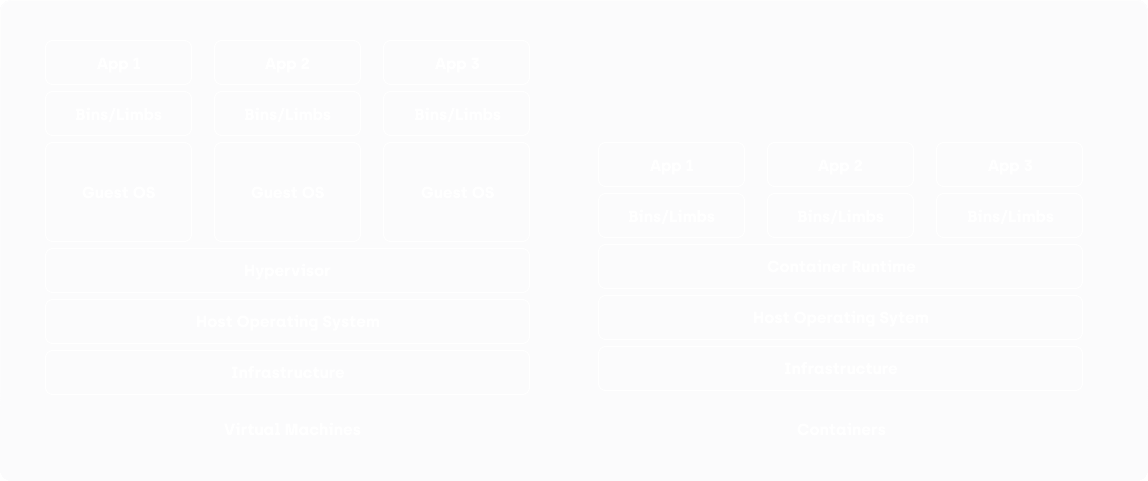
Serverless Architecture
It simplifies work by allowing developers to write and deploy code without having to worry about the infrastructure. All infrastructure management and scaling is handled by the cloud service provider. This allows developers to focus solely on writing code, accelerating time to market, and providing a high level of availability and scalability. ###Container-based architecture
- Containers enable developers to build isolated runtime environments where applications can operate independently
- Each container can hold only the necessary dependencies and runtime environment for the application, reducing the application size and enabling easier management.
Source code organization
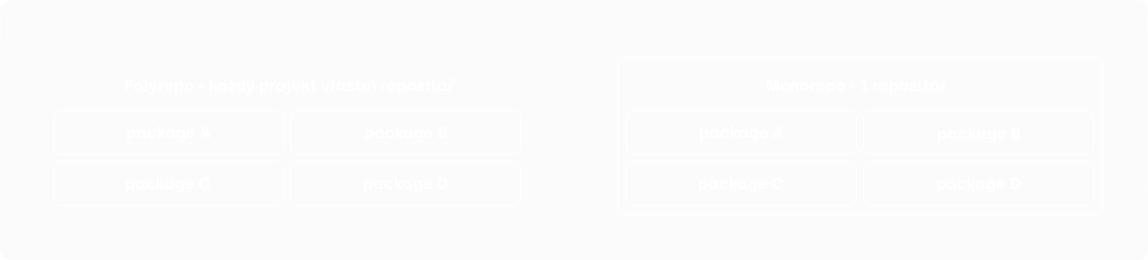
Polyrepo
- An architecture where each project has its own repository.
- This approach is well-suited for projects composed of many loosely coupled components, allowing for parallel development and updates.
- Teams and developers can work autonomously on their respective repositories, enhancing collaboration and agility.
- A polyrepo simplifies version control by isolating changes within individual repositories, improving traceability and reducing merge conflicts.
Monorepo
- An architecture where all projects are stored in a single repository.
- This solution suits projects with common parts and can share code.
- This means that a change in one part can affect other project parts.
- Monorepo also makes it easier to share code between teams and solves version compatibility issues.
Backend
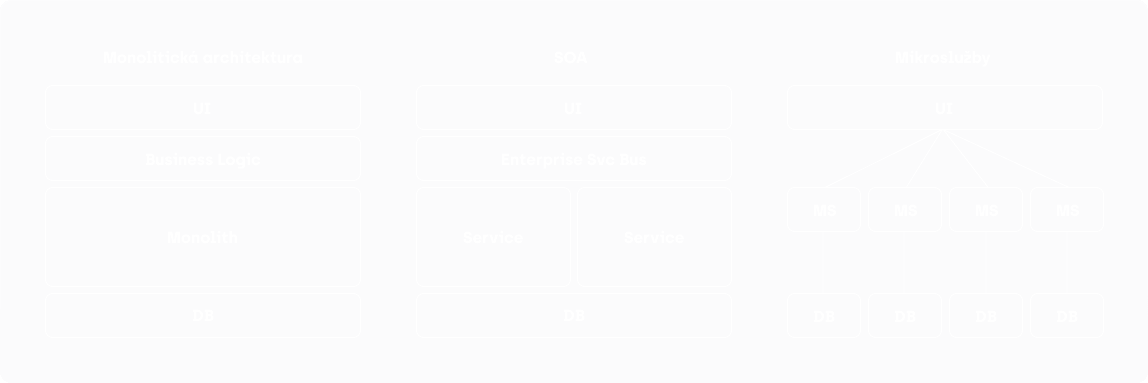
SOA (Service Oriented Architecture)
- It focuses on the separation of software functionality into separate services.
- These services are then available to other applications that can use them.
- The individual services are designed to be as independent of the other services as possible, allowing one service to be easily replaced or updated without having to change the entire application.
EVA (Event-driven architecture)
- It allows developers to create applications that react to events in real-time.
- It complements service-oriented architectures because these services can be triggered by triggers that run on incoming events.
- Any state change in an application can trigger an event that triggers a response in another part of the application. This allows the creation of highly reactive software and greatly reduces dependency on the timing and performance of other parts of the application.
Monolithic architecture
- It combines all the components of the application into a single unit, making it easier to develop and deploy at the beginning of a project.
- The simplicity of development is an advantage as everything is in one module. As the application grows, managing dependencies becomes more challenging.
- Poor scalability occurs as the application grows, where each change can affect the entire system, limiting flexibility and slowing deployment.
Microservices
- An increasingly common choice for customized software design.
- It allows you to separate your application into smaller services that are independent of each other and can be developed and deployed independently. This enables more agile software development and deployment.
- Each service can be written in a different language and use a different database, allowing developers to use the best tools for each specific service.
Frontend
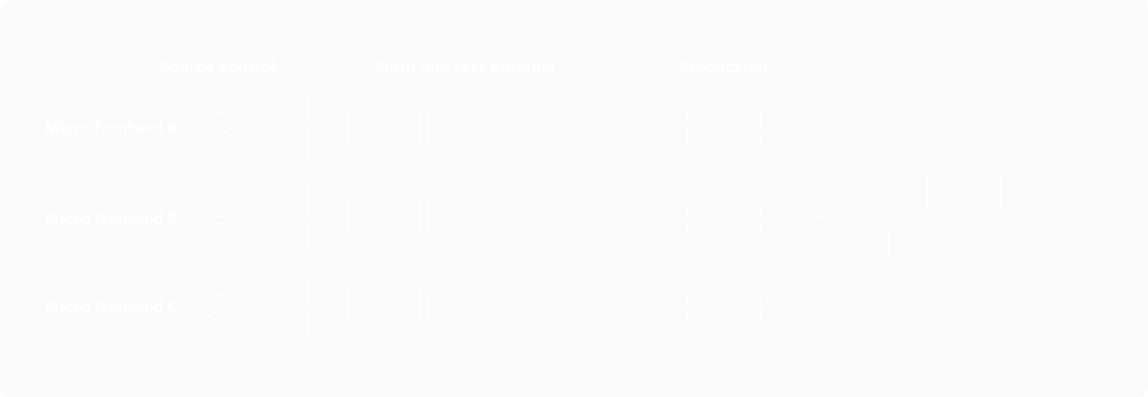
Component architecture
- It divides the application into smaller parts - components (e.g. button, calendar, table) and these are developed and deployed separately.
- Allows for faster development and scalability due to its reusability within the application.
- However, there are still some issues with integration and code sharing between components.
Microfontends
-vIt is a division of the application into separate isolated sub-applications - micro-frontends (e.g. chat, reservation management, accounting visualization).
- They are based on component architectures and have the same advantages. However, the main difference is that it is these sub-applications that can be easily reused in different applications as larger units rather than just components.
- Micro-frontends can independently share only the libraries and components they need.
- This approach solves many of the problems associated with traditional frontend architectures, such as speed of development, scalability, and ease of integration.
Fullstack (outdated
MVC (Model-View-Controller)
- It focuses on the separation of data presentation (View), application logic (Controller), and data model (Model).
- This approach makes it easy to modify individual parts of the application without affecting other parts.
- For example, a change in the data model may not affect the way data is presented in the user interface.
MVVM (Model-View-ViewModel)
- It builds on the MVC architecture but adds another layer - ViewModel, which serves as a link between the data model and the user interface.
- This approach allows easy separation of code for the user interface and application logic, which simplifies testing and customization.
Summary
These architectures can also be combined. For example, we can have a service-oriented architecture (SOA) with several reactive functions over time (EDA principles) that is fully containerized and connected to a component architecture. Polyrepo is suitable for projects that have many independent parts, while Monorepo is suitable for projects that share common parts.
For smaller enterprises, it is common to start with a monolithic architecture that is gradually broken down into sub-units/modules or individual services/components and optimized. In contrast, for larger applications, where several dozen development teams may be working on them, work is usually started directly on individual microservices and micro-frontends after the architecture has been designed.
Each of the architectures has its advantages and disadvantages, and the choice depends on the needs and goals of specific projects. When designing the architecture, it is also very crucial to consider the long-term project budget and the capacity of the team.
Finally, we would like to emphasize that every few years the architectural approach to software development is dramatically innovating. Companies then try to keep up with the times so that their competitors don't run away from them, but many of them choose the new architectural path wrong, only increasing their technology debt and making it difficult to manage half-baked solutions in the long run or continuing on the old tracks. In such cases, we always recommend consulting an expert.
We believe you now have a better understanding of the difference between architectures in custom software development. If you're interested in going more in-depth or have more questions - we're here for you.